Evidence-based risk reviews for contracts, detections and code
ScopeWise reads the SOW, the SIEM rule set or the scanner output, scores the gaps against named frameworks, and hands you the client-ready report. Deterministic numbers. AI only where it is honest.
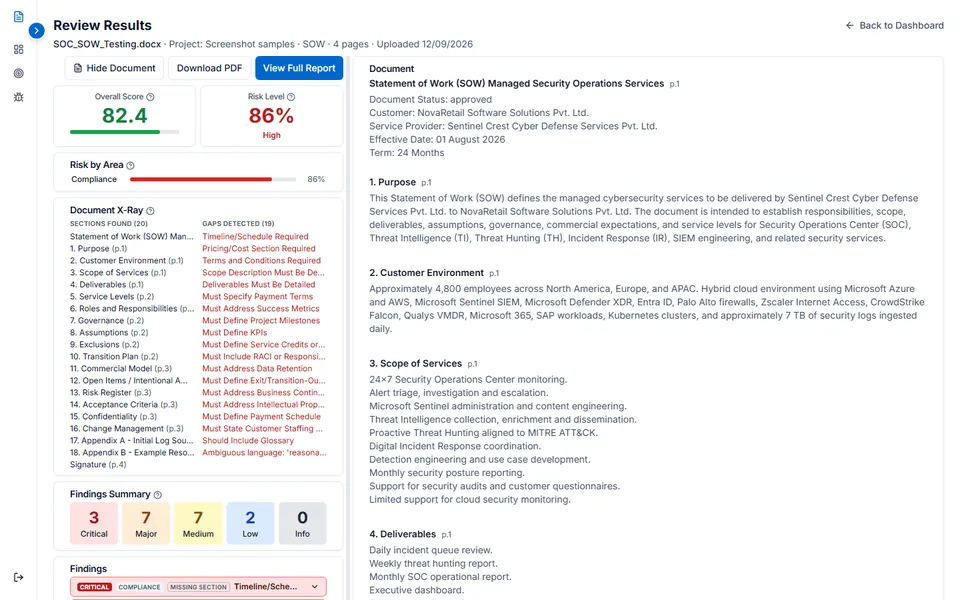
SOW & RFP Review
Six specialist AI reviewers plus a deterministic rule engine. Risk score, evidence quoted per finding, fix-verification on re-review.
Learn more →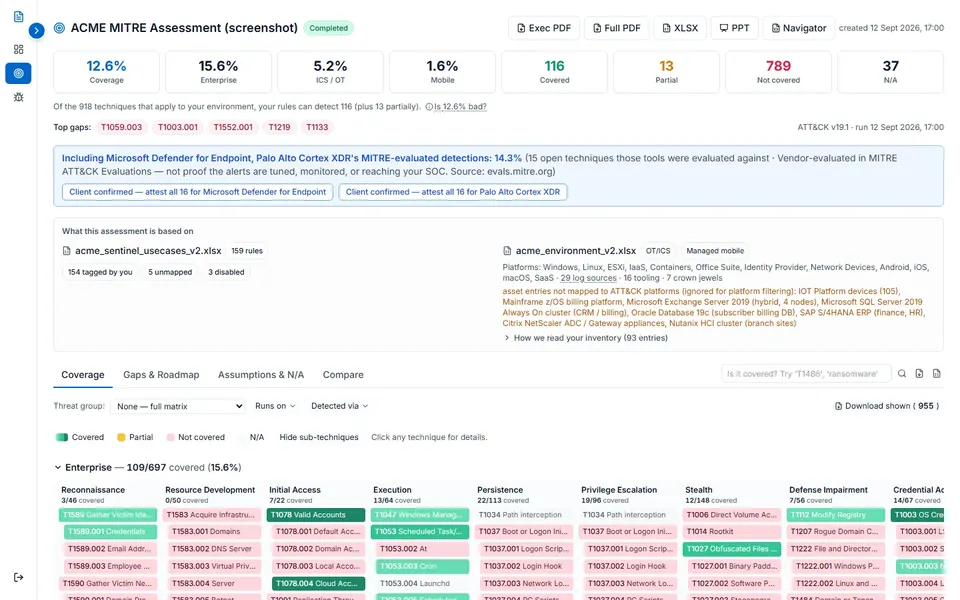
MITRE ATT&CK Coverage
Upload your detection rules and environment inventory. Get coverage by tactic, ranked gaps, a 90-day roadmap, and the PPTX, XLSX and Navigator layer to present it.
Learn more →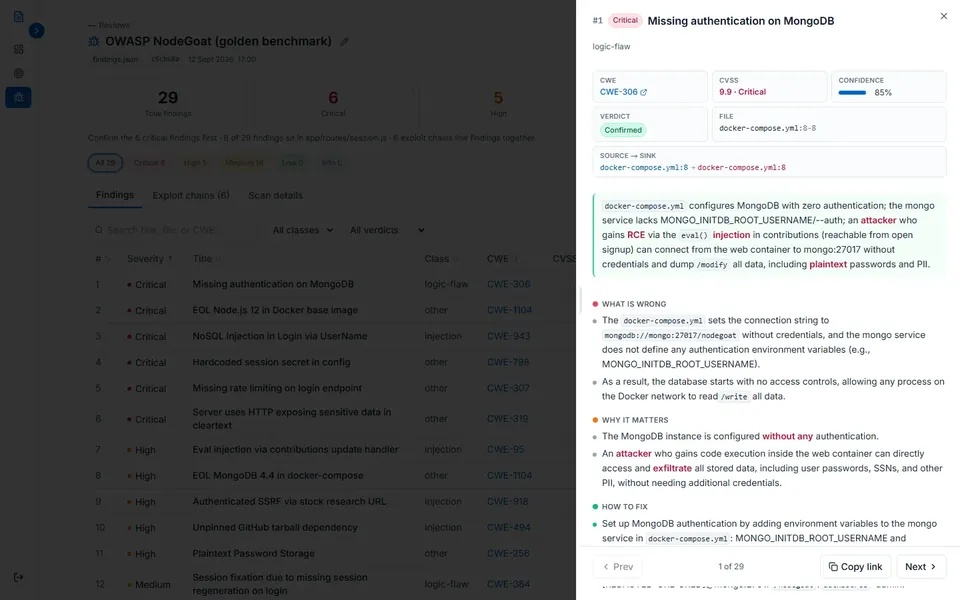
Code Security Review
Run the open-source scanner on your side. Upload findings only. Get a plain-language register, exploit chains and the fewest fixes that break every chain.
Learn more →How it works
Upload the artifact
SOW or RFP, SIEM rule export plus environment workbook, or scanner findings.json.
Scored, evidence-backed review
Every finding is tied to the clause, rule or code location it came from; numbers are computed by code, not by the model.
Client-ready exports
PDF, XLSX, PPTX, ATT&CK Navigator layer.
Why consultancies use it
ScopeWise replaces the spreadsheet-and-deck workflow behind each of these assessments. The report is generated, not assembled.
of annual revenue lost to poor contract management
Source: World Commerce & Contracting (WorldCC)
of MITRE ATT&CK techniques detected by the average enterprise SIEM, while telemetry exists for over 90%
Source: CardinalOps, 2025 State of SIEM Detection Risk
typical cost of a manual internal penetration-test engagement
Source: Bright Defense, penetration testing pricing guide
Your data stays yours
- No raw logs, no source code: you upload rule metadata, environment inventory or scanner findings only.
- Only minimal rule excerpts are sent for AI tagging; the model never emits a coverage number.
- SIEM credentials are encrypted with AES-256-GCM, write-only after saving, and every SIEM connection is read-only.
- AI calls go through a single provider (OpenRouter); your data is not used to train models.
- Data is encrypted at rest and in transit and scoped to your organization.
Who it is for
Procurement & Legal
Triage vendor SOWs and RFP responses by actual risk before award.
Security consultancies & MDR
Detection-coverage assessments and code reviews as repeatable deliverables.
AppSec consultants
Turn scanner output into a register, exploit chains and a fix plan the client can act on.
Also see ScopeWise for legal teams and agencies.
From the blog
An RFP and a SOW read like cousins but do different jobs -- one asks vendors to propose, the other defines what a winning vendor will deliver. Here is what a review has to check differently in each, and what stays identical.
A scanner produces a JSON file of raw hits. A code security review report is something else -- verified findings, exploit chains, and a fix plan a client can actually work.
A Navigator layer looks like a finished picture of your detection coverage, but the colors are a summary of choices someone made upstream -- here is what to check before you trust the grid.